By Innocent
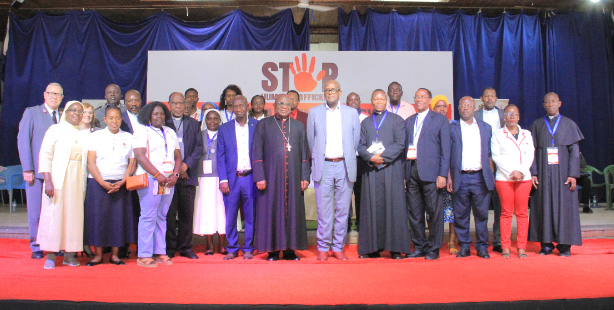
Kampala, Uganda: In a powerful display of ecumenical unity and shared purpose, religious leaders from the Uganda Episcopal Conference, government officials, civil society organizations, and international partners gathered for a national day of prayer, partnership, and reflection dedicated to combating human trafficking and modern slavery.
The event, which brought together over a hundred people including children, Students, NGO’s and survivors, emphasized a central theme: true and lasting peace cannot exist where human dignity is violated, and the fight for peace must begin with securing the dignity and freedom of every individual.
Peace Begins with Dignity
The Archbishop of Kampala Archdiocese Most. Rev. Paul Semwogerere while addressing the congregation began by focusing on the absolute sacredness of human value. He emphasized that peace cannot begin in boardrooms or parliaments; it must begin with dignity. He noted that true peace is completely missing wherever a person’s dignity is taken away, their freedom is denied, or where they are exploited.
He reminded the congregation that it is easy to look at human trafficking as a set of numbers, but every single statistic represents a human life. He listed the faces behind the numbers: a child, a young woman, a young man, a migrant worker, a mother, a father, a brother, or a sister whose freedom has been stolen.
The Archbishop made a special, direct appeal to the religious leaders present, stating that churches and mosques reach people and places that governments and civil society can never reach. Because of their presence in villages, schools, families, hospitals, prisons, and refugee settlements, they have a unique and special responsibility.
He challenged religious leaders to use their tools to fight back:
The Pulpit: Must be used to teach people how to recognize the signs of trafficking.
Youth Programs: Must teach young people to spot deceptive and fake online or offline recruitment tactics.
Marriage and Family Ministries: Must directly confront abuse and exploitation within homes.
Congregations: Must be taught exactly where and how to report suspected trafficking cases.
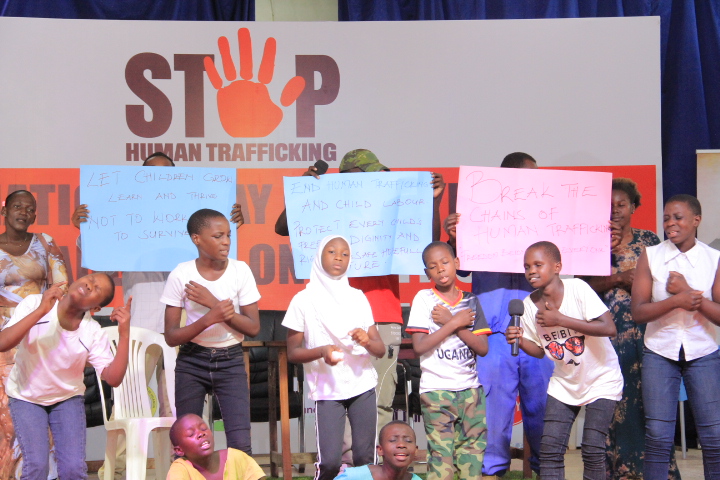
| A group of children from Mwagale Foundation on stage performing a skit about fight against Human Trafficking |
Addressing the congregation, Colonel John Murray, representing the Salvation Army in Uganda, delivered a stirring greeting, noting that the response to human trafficking is a core expression of Christian faith and a global obligation.
“Peace does not begin in boardrooms or parliaments,” leaders noted, pointing out that true and lasting peace must be built on the absolute respect for human value. Colonel Murray, outlining the Salvation Army’s international framework focused on prayer, prevention, protection, and partnership, reminded the audience that while statistics are necessary, they often mask the human reality. “Behind every number is a story, a family, and a precious soul yearning for freedom and respect.”
Monsignor Charles Kasibante, representing the Archbishop of Kampala, welcomed the guests and commended the commitment of all partners. He noted that human trafficking is not just an international issue but a deeply domestic one, emphasizing that many victims are trafficked within Uganda’s borders, such as vulnerable young people lured from regions like Karamoja to the streets of Kampala.
Harrowing Tales of Survival
The solemnity of the day was underscored by firsthand testimonies from survivors, which brought the human cost of modern slavery to light.

One survivor, Betty, shared her painful journey of being trafficked to Dubai under the guise of domestic employment. Upon arrival, she faced extreme exploitation, isolation, and eventually, homelessness on the streets of a foreign country after resisting abusive demands from her employers. She survived for weeks by scavenging for food until she was assisted by a fellow domestic worker and eventually returned to Uganda.
Another survivor, Claire Kabubu, recounted a terrifying experience of being deceived by a foreign national with promises of a luxury job and study opportunities in China. Instead, she was manipulated into trafficking drugs, arrested in Iran, and sentenced to death by hanging. She described the fear, manipulation, and psychological control used by traffickers, including the confiscation of passports and the use of sophisticated technology. Fortunately, through divine intervention and legal assistance, she survived the ordeal.
Shockingly, some survivors described being subjected to medical testing where their internal organs specifically their kidneys were targeted for harvesting under the cover of mandatory medical examinations. It was only through deep suspicion and the courage to refuse to sign deceptive paperwork that some managed to escape the organ-harvesting rings operating within trafficking corridors.
The Digital Shift in Trafficking Tactics
Government representatives and law enforcement officials highlighted how the landscape of human trafficking has drastically changed. Commissioner of Police Julius Twinomujuni, from the Ministry of Internal Affairs, explained that traffickers are increasingly abandoning traditional recruitment methods in favor of digital platforms.
“The smartphone has become a major tool for recruitment,” Commissioner Twinomujuni warned. He revealed that trafficking networks are highly adaptive, utilizing artificial intelligence, encrypted messaging apps, and sophisticated technology to run online recruitment scams, cyber fraud, and illicit financial operations.
Twinomujuni shared that law enforcement recently discovered advanced setups where single operators control dozens of phones connected simultaneously to execute cross-border scams. He stressed that legislation alone is insufficient; communities must remain vigilant and report suspicious activities in their neighborhoods. Furthermore, authorities called for strict tracking of international SIM cards often used by criminals to bypass local surveillance.
A Call to Common Action
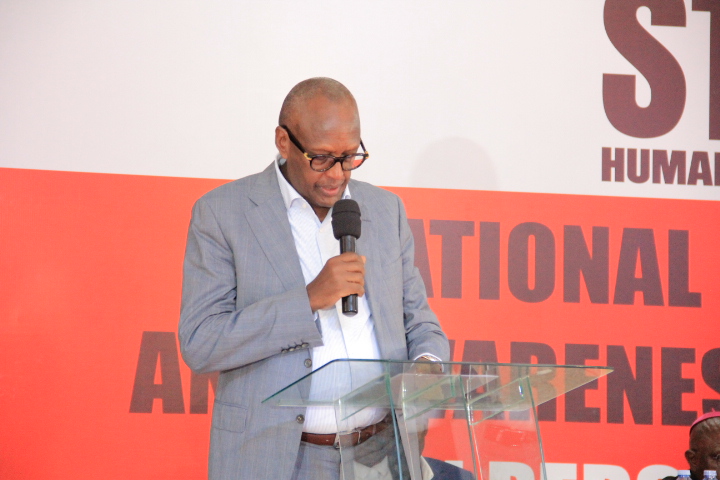
The Guest of Honour, Major General (Rtd.) Henry Tumukunde, the Minister of Gender, Labor, and Social Development, representing the Prime Minister, praised the religious community for organizing the prayer service. In his address, Gen. Tumukunde committed the government to concrete policy reforms, announcing that the state would move toward printing and auditing travel documents in bulk after rigorous screening to reduce the extortion and manipulation of young travelers. He also pledged that the government would intensify its focus on Karamoja, identifying it as a crucial hub for intercepting internal trafficking rings.
Religious and civil leaders concluded the day by outlining a clear path forward, calling on the Church, mosques, and communities to become sanctuaries of protection and education. Because religious institutions exist at the grassroots level in villages, schools, and families they possess a unique responsibility to spot deception, raise awareness, and support survivors with compassion.
Faith leaders pledged to use their pulpits, marriage ministries, and youth programs to educate congregations on safe migration, genuine job recruitments, and online safety.
The day closed with a three dimensional prayer for the nation:
- For Conversion: That those who profit from human suffering will have a change of heart and turn away from exploitation.
- For Healing: That survivors and their families may find restoration, justice, and hope.
- For Courage: That communities will refuse to stay silent or look away when exploitation happens.
As the event concluded, leaders reminded the nation that the true measure of a society is not how it treats the powerful, but how it protects and restores the vulnerable.